Monday, December 24, 2007

Excellent use of self defense principles

From News.com.au comes this story:

December 20, 2007 06:51pm

A 95-year-old World War II veteran dared two knife-wielding home invaders to kill him.

Robert Taylor was sitting on the front veranda of his home in Liverpool, in Sydney's southwest, when two men tried to rob him yesterday afternoon.

One of them threatened him with a knife while the other went inside the house, cut the phone line and then rummaged through the elderly man's belongings.

Mr Taylor said the men told him to get inside the house or they would kill him.

He said he refused and dared them to carry out their threats.

"I said to them while they were standing there,'If you are going to kill me, kill me now','' Mr Taylor said on Channel 10.

The men fled without taking anything.

Mr Taylor, who served in New Guinea and Bougainville during WWII, had a message for the men.

"Wake up to yourselves and go and get a job, there's plenty around,'' he said.

Police described the incident as a "callous, cowardly attack''.

I really like this one. It demonstrates a number of important self defense principles that are easy to forget under pressure.

First, most people are lazy and prefer to do things on autopilot. This includes a lot of criminals. As long as things are going the way they want everything is good (for them, not for you). When something unexpected happens it takes time to refocus and do something else. Effective self defense rests on making things not go the way the criminal wants. Mr. Taylor made the lowlifes start reacting to him instead of the other way around.

Napoleon said "I might lose a battle, but I will never lose a minute." The earlier you mess with the bad guys' plan the better. This gentleman started his self defense the moment the criminals started their crime. The further along things go the more he's got invested in doing this particular crime right now.

Make them realize that what they want from you is not worth what they're willing to pay. Mr. Taylor guessed (correctly) that they weren't willing to kill someone in front of witnesses in the middle of the day. He gave them the choice of doing that or leaving. They left.

All of these are principles. When we taught self defense we had very few iron clad rules. One of the biggest was "Never ever allow yourself to be taken to a secondary crime scene or restrained. Nothing good can happen if you give a criminal the time and privacy he wants. If you let yourself be made helpless it just lets him get creative with the blowtorch and pliers." The defender refused to go into the house where g-ds alone know what the two thugs would have decided to do.

I suppose it could have been better. He could have shot them both between the eyes. The story is a beautiful example of the fundamentals of self protection.

Thursday, December 13, 2007

A little good news with the bad - A real American Hero


A Muslim saves Jews who were being attacked by Christians for saying "Happy Chanukah." Sometimes things happen that give you a little hope for the human race.

A suspected bias attack on four Jewish subway riders has resulted in a friendship between the Jewish victims and the Muslim college student who came to their aid.

Walter Adler is calling Hassan Askari a hero for intervening when Adler and three friends were assaulted on a subway train in lower Manhattan on Friday night.

The altercation erupted when Adler and his friends said "Happy Chanukah" to a group yelling "Merry Christmas" on the Brooklyn-bound train.

The 20-year-old Askari said he tried to fight off the 10 attackers, giving Adler a chance to summon police by pulling an emergency brake.

"I did what I thought was right," said Askari, a student at Berkeley College in Manhattan, who was allegedly punched and beaten. "I did the best that I could to help."

Eight men and two women have pleaded not guilty to assault, menacing and other charges in the case. Prosecutors have said the charges could be upgraded to hate crimes.

According to this article

Four Jewish subway riders who wished other people "Happy Hanukkah" were pelted with anti-Semitic remarks before being beaten, police and prosecutors said. The incident was being investigated as a possible hate crime.

The four were on a train in lower Manhattan on Friday night, during the eight-day Jewish Festival of Lights, when they were approached by a group of 10 people who offered holiday greetings. The victims responded, "Happy Hanukkah," and then were assaulted by the larger group, police said Tuesday.

[...]

One of the men charged, Joseph Jirovec, pleaded guilty last year to attempted robbery as a hate crime and was awaiting sentencing, prosecutors said. Jirovec, who is white, was part of a group that yelled racial epithets and assaulted two black teenagers in Brooklyn, prosecutors said.

Jirovec's lawyer, Peter Mollo, said Tuesday it was very unlikely his client would attack another person for being Jewish.
Hassan Askari, you're an authentic American Hero. If you weren't Muslim I'd say "Drinks are on me." But as it is, you have my profound thanks and heartfelt prayers. You fought evil, protected the innocent and brought honor on Islam. That's Muslim Chivalry and American ideals at their best.

Damn. Damn. Damn.

I hate to be the bearer of bad news, but Terry Pratchett has been diagnosed with a rare form of early onset Alzheimer's.

Folks,

I would have liked to keep this one quiet for a little while, but because of upcoming conventions and of course the need to keep my publishers informed, it seems to me unfair to withhold the news. I have been diagnosed with a very rare form of early
onset Alzheimer's, which lay behind this year's phantom "stroke".

We are taking it fairly philosophically down here and possibly with a mild optimism. For now work is continuing on the completion of Nation and the basic notes are already being laid down for Unseen Academicals. All other things being equal, I
expect to meet most current and, as far as possible, future commitments but will discuss things with the various organisers. Frankly, I would prefer it if people kept things cheerful, because I think there's time for at least a few more books yet :o)

Monday, December 10, 2007

Today's Martial Arts Topic: Affect

A long time back, when dinosaurs strode the Earth, before Martial Talk, before Instant Messaging, before HTTP, when e-mail addresses (if you were lucky enough to have one) had !s in them, I did Kajukenbo. Al Dacascos was in Portland. He'd moved his school from Murray Road to Highway 8 right across from the Lexus dealership and the Dairy Queen. One of the new features of the school was notebook pages and lists of requirements for every student at every level.

I couldn't stand the half handwritten half typewritten badly photocopied pages. So I typed them into MacWrite and printed out master copies. Strange things happened because of that. I ended up editing the IKF newsletter for a couple years and tried to make working class guys from Hawaii sound like college professors - a challenging job of editing. They also had me go to a couple of the yearly meetings and write them up making it sound like everyone got along swimmingly and peace, love and brotherhood were the orders of the day.

These are martial artists we're talking about. Let's say that a bit of selective blindness and some out-and-out lying was required. Watcha gonna do

The first meeting was in a hotel. Tiel and I were supposed to direct everyone to the meet-and-greet as they arrived. It wasn't hard. A few people were wearing Kajukenbo t-shirts of one sort of another. But the rest? There was a look, an affect that was very common. We didn't miss many. There was a sort of walk, almost a swagger, that a lot of them had. There was also a certain sort of erect carriage and highly developed forearms that set them apart from everyone else.

I think Tiel had it pegged. She was talking about a group of the senior practitioners and said "They're Palama boys. They grew up on da Islands and some of them never did adjust to the mainland. Most of them [one group] except X and Y and Z are still kids. They take their martial art seriously, but they're basically tough guys, brawlers who are up for a fight on Saturday night." There's a quality to the way a lot of them move that reminds me (surprise, surprise) of a lot of Kenpo stylists. It's like the torso is a solid gun platform, and the arms and legs moving around are the guns. I don't know how to express it.

Now, that's not to say that all Kajukenbo practitioners are like that. Not at all. But when you compare a chunk of them to a lump of other martial artists it sort of stands out in the aggregate.

Just recently I was reading an Australian kids' book called "Toad Rage". That led to thinking about Cane Toads and the last thing I tried to put in the Kajukenbo newsletter. And that finally led to thinking about the Kajukenbo Look and what stands out in people from other styles.

Some. I don't know exactly what it is that screams "Cop" in a person's bearing, but Phil Messina's people all seem to have it, even the ones who are not in law enforcement.

The smug superiority and false politeness of just about every single Ki Society Aikidoka I've met never fails to set my teeth on edge. It's led to more than one unfortunate but amusing incident

When Tiel met three koryu practitioners who teach under the same instructor here in Portland she said "Thugs. Well behaved, educated amiable thugs." And she's right. They're not that sort of person, but they sure carry themselves that way.

Krav Maga was a special case. When I took it for a very short time I talked to the guy leading class, and we've had conversations with other ones. They all agreed that if you don't have the right affect you aren't going to make instructor. Now, that's a little extreme, and I think it's unnecessary. But it's their party, so they can do what they want to. I think it's interesting that they're aware of the fact and use it.

A few things really stand out in the Thai boxers we've hung with. They don't swagger. They don't tend to brag. There's a certain value placed on politeness and humility though not subservience. There's also a serious "Show me" attitude. You make a claim, you'd better be able to back it up. That and the sort of toughness that comes from knowing you're fit, strong and can take it as well as dish it out.

It's sort of similar to the MMA guys. They look and act like, well, serious athletes in an extremely demanding sport. Excellent overall muscular development and a certain confident grace in movement. You tend to find the arrogance of the serious competitor coupled with very good sportsmanship.

A lot of people who do FMA don't have much contact with Filipinos. Still, there are things that rub off. A few years ago I would have said "quarrelsome". To some degree I still would. Hey, I call 'em like I see 'em. And I see 'em like I was There's more at work. And I think I've figured out part of it. In a lot of the "Chopstick Culture" Asian martial arts - Korea, Japan, China - there's a very hierarchical tradition. You have a rank, a title and seniority. That tells everyone (including yourself) who and what you are within the group. Things and people move in well-defined ways.

Among the FMA there's a lot of organizations and some fancy titles and ranks. But it's more fluid. I swear that every guy who had a fight with his teacher moved to the other side of town, made up a new salute and became the Grandmaster of his own slightly modified system that had absolutely nothing to do with the guys across the way

It's less like a beehive than a wolf pack. In the hive your duties will change, but who and what you are is always rigidly defined. Among wolves it's all about respect. The respect you get and your position is always up for negotiation. Back down from a challenge, and you've negotiated yourself downwards. Make too many challenges and you're a troublemaker. Challenge too high or too low, and you're not to be taken seriously.

I think that's why there's a stereotype that eskrimadors will fight at the drop of a hat, and if one doesn't drop they'll throw in their own. It's not entirely or even mostly true, but it stands out compared to a number of other traditions. And I think that's a good part of why.

When we did more FMA we picked up on it. We took more things as challenges and were more ready to see how our steel was tempered. Of course, we were also almost twenty years younger. But that couldn't have anything to do with it. Nah Tiel definitely picked some of it up from Suro Mike Inay's group when she studied there.

Just to pick an example, we had a table at the Oregon Knife Collectors' show once years back. A guy who later made quite a name for himself started talking trash about Guro Inosanto. "He's got some sticks, but that's it. He doesn't have any real martial arts." Now, people talk trash about Guro Inosanto all the time. It's usually pretty clear that it's a reflection on the guy doing the insulting, so you let it slide. At the time Tiel took it as an insult to her teacher's teacher and therefore a challenge. She was more than half serious about grabbing her sticks and seeing how the guy's steel was tempered. No matter how that fight would have ended it would have been bad for him. "Famous martial artist whacked upside the head by 120 pound gal" or "Big strong martial artist beats up woman half his size"

The point isn't who would have won the fight. It's that she had that FMA attitude of "Don't make challenges. Never back down if you are challenged."

Or there was the story Sifu Tony Ramos told about when he was working as a cop in Vacaville. The PR-24 had just come out, and everyone was getting trained. When the instructor uttered the sneer "Well, I see you're still carrying a baton," it was like a Greek tragedy. A Greek tragedy right after the main character has insulted Blind Tiresias and gone against the Will of the G-ds. I knew how the story goes after that. It ends a short act later with the instructor laid out on the floor.

These are generalizations. Obviously. Obviously. Obviously. No doubt. But there's a surprisingly large kernel of truth in some of them. You can learn a few things from the exercise. It's hard to say how much is self-selection and how much is induced. That varies from school to school and person to person.

One thing that's pretty clear is that nobody is qualified to apply the lens to his or her own style. It's like trying to see the surface from the inside. And all of us know we've got a case of "What I do is great. If there were something better I'd be training in it," when we're being honest. I know there's a Silat affect or a couple of them. But I'm too close to see it myself.

So what are some of the things that strike you about different traditions or styles? What can you look at in the practitioners that stands out and distinguishes them from other martial artists?

Friday, December 07, 2007

Wisdom


Six wise blind elephants had heard of human beings and wanted to know more about these mysterious creatures. So they had a human being brought to them.

The first elephant touched the human being and declared "Human beings are flat."

The other elephants touched the human being and agreed. Human beings are flat.

Rare Exports - What It Takes

Warning: These clips contain graphic footage of cruelty, hunting, brainwashing, imprisonment and worse. But it's a sacrifice we must make to preserve our most Sacred Traditions. This holiday season tell yourself "It's for the Children."

Part I - Rare Exports


Part II - The Consequences of Failure


Sunday, December 02, 2007

Kids' Martial Arts The Way it Should Be


Whenever people ask "What martial art do you recommend for kids?" I always answer "Judo. No question about it."

There's a lot of reasons for this. It's wrestling, and little apes love to wrestle. You learn to fall. Most people never get in a fight, but everyone falls down. It wears them out. It's great exercise and does wonders for balance and coordination. It develops fighting spirit in a good way. Striking is bad for young unfused bones and can lead to permanent joint problems in ways that grappling just isn't. It works just fine for schoolyard troubles with a lot less chance for accidental injury than kicking some kid in the head.

Most of all it was my own experience in the early 70s.

Saint Street goes from one side of Richland, WA to the other. It starts at the Columbia River and heads West past the water treatment plant. It goes up a hill and crosses Stevens Drive, right where Stevens merges with the Bypass Highway. The trees and grass end suddenly at the range of the last home sprinkler system and give way to bare dirt, tumbleweed and bunch grass.

Right across Stevens there's a gas station which used to say "Last Gas for 7o miles". In those days it was true. Back then there was a Coke machine instead of a mini mart.

Just beyond it are two WWII era buildings built by the government for some mysterious Hanford Project purpose. All that construction to the North and West in the picture came decades later.

The first one has a green roof and flaking white paint. It used to be a martial arts school. Sensei Rising taught Ju Jutsu, Aikido, Karate and a number of other mysterious things. Lord only knows where he picked them up. All I can say for sure is that he and a couple of the other teachers there had officially been frogmen during the Second World War. He had a signed picture of William "Wild Bill" Donovan in a place of honor and seemed to know a really strange array of martial artists. I'd still give a lot to know how to find the Ba Gua and Dog Kung Fu teacher he brought to the Judo school for a demonstration one evening.

Kids my age weren't allowed to study there. He sent anyone under 21 including his own sons next door to the building with the brown roof where a really great group of men taught Judo.
It's the standard by which youth martial arts should be judged. I've seen a lot of kids' classes - all the Karate/TKD/Kenpo variants, Kung Fu, and about a million "Little Dragons" and "Junior Ninjas" programs. Some of them are very good. The Richland Judo Dojo could hold its head up with any of them and outshines almost all.

The facilities were nothing much to look at. It was a mid-1940s military building, ugly and sturdy. There was some heat in the Winter, no air conditioning in the Summer, a kids' locker room, and adults' locker room, two rooms with tatami mats and a back room filled with dusty exercise equipment. Dues were minimal and barely covered the costs of the facility. A couple times a year one of the school mothers would do a group buy of gis.

The teachers were a collection of friends. Most of them had picked up their Judo in the Service. They were mostly steam-fitters, engineers, government employees and other people who worked out in the Hanford area. Many of them had sons in the classes they taught. Years later a lot of them quit Judo and formed an amateur soccer team. They had a refreshing faith that if everyone just went to the dojo three times a week and trained hard in Judo the world would be a better place. And do you know, I think they were right.

New kids were taught in a group in the back room. When they could fall without getting hurt and had learned a couple throws they were moved into the main class. There were classes for adults and advanced belts only, but for the most part everyone was taught together. Everyone did light randori together. Everyone lined up by rank together.

Competition was important. We worked extra hard and got a lot of motivation before big tournaments. But there were no display cases of trophies, and there was no special emphasis on the hot competition prospects (and there were some). The emphasis was taking part, fighting hard, and learning.

Looking back I'm impressed by the results. Over the four years I was there less than half of the students I started with left. Everyone progressed, but nobody passed a belt test who didn't deserve to. There was a group identity that extended outside the dojo. Effort was rewarded more than talent. A number of kids got things important things from Judo that they didn't get at home. We got good solid Judo training and had a lot of fun. You really can't ask for more than that.

Why was it so good? Can it be repeated?

It would be hard. It was a combination of time, place and people which made the school what it was.

There is a lot more martial arts now, and for better or worse people have expectations about them and what a school should be like. It is much harder for kids and parents to take a school on its own terms instead of in the light of Karate Kids, sword-wielding reptiles, Jackie Chan and the UFC. Judo classes were more an alternative to basketball or wrestling than they were to Karate or Ninjutsu. The only other dojo I had heard about taught Tae Kwon Do out in the wilds of West Richland.

Part of it was the teachers. They were an exceptional bunch. There was a most senior teacher, but he didn't run the school. A loose group of school mothers did that in one of those mysterious female networks what men wot not wot of. The fact that their own sons were in the class helped keep quality up. The fact that there were several prevented favoritism. They really believed in the benefits of Judo and felt that it was something bigger than them. They took a very paternal or at least avuncular role to the students. A lot of them had what I now see as a top sergeant's attitude. No nonsense, not soft, but dedicated to the people for whom they were responsible.

Another important thing was the students. Since there was no need to make money the teachers could take whom they wanted and teach the way they thought best. I'm sure a few kids never made it past the initial interview, and trouble makers shaped up or didn't last long. Bad behavior was not tolerated, and their response to the one ethnic slur I ever heard was grimly intolerant. They acted shamed that something so "against Judo" would happen in their school. They were there to get a workout and teach Judo. Part of that was turning out young people who would be a credit to the Art and their country.

The club didn't take any students younger than nine or ten. The childhood development issues that you get with the three-to-eight set just weren't there. It was a club that met in the evenings, not an unlicensed after school daycare program. And it was part of "family and friends life" for the teachers rather than a separate activity. All of this set the tone in a lot of subtle ways. Most of them were good.

I don't know if mixed-age classes were an official part of Judo at the time. That's the way it worked out. I think we were better for it. Most were at an age where they wanted to copy what adults were doing and were proud to be accepted into an adult activity as junior but definitely part of the group. We were all Judo players together. Obviously, a six foot four wrestler who had been to the Nationals was going to go easy on a skinny ten year old in light randori. Just the fact that they worked out together was valuable.

Friday, November 30, 2007

Loyalty Oaths

It was bad enough during the Truman and Eisenhower years. During the Red Scare University professors and anyone else the government deemed insufficiently patriotic and "soft on Communism" could be forced to take a loyalty oath. Not the Pledge of Allegiance but an affirmation that you weren't now, never had been and wouldn't be part of any subversive organization. The Supremes went back and forth on their constitutionality but finally came down against them. Colleges that refused to demand the oath lost government funding and even broke tenure for professors who refused to sign them.

In recent years the Republicans have revived the idea. If you want to attend an event where Bush is speaking you have to sign a pledge of personal loyalty to the Decider. Don't sign the Oath, don't go. This even includes active duty Servicemen and Servicewomen when he visits the troops. I suppose that billboards proclaiming him "Our Leader" were only logical.

Now it seems that the GOP has taken the next step.

Vote Virginia who want to vote in the presidential primary are now forced to sign an oath pledging that they will support the Party's nominee in next year's election. It doesn't matter who it is. It doesn't matter if you prefer the Democrats' choice. You can't vote your conscience and cast a ballot for the Libertarians. If you want to be part of the selection process you must either lie or sign away one of your most sacred civil rights to The Party.

The stated reason is that Democrats don't care who their Party throws up for the general election. They'll come in droves to vote for the Republican they believe will lose. It's a stupid solution to a non-problem. It won't survive the inevitable court challenge. But it does show the GOP's true values - rigid Party Loyalty, strict adherence to the Party Line and devotion to the Person of the Unitary Executive.

Even conservative papers like Reason and The Spectator are shocked at this one. The Weekly Standard barely raised an eyebrow saying that there's no evidence that voters cross over this way.

Me? I threw up in my mouth a little.

Quiz - How Insane Are You?

My favorite Internet Personality Quiz courtesy of the H.P. Lovecraft Historical Society, creators of the musical A Shoggoth on the Roof as well as movies, Elder Signs and many fine products for Eldritch Investigations.

Your score is: 155

For easier understanding, the HPLHS SaniTest assessment algorithm converts your raw score to a scale of 1 to 10. This number is your INSANITY INDEX.

INSANITY INDEX 9.11 Well, that's a pretty high score. Science lacks an official term for your condition, but around the lunch table psychiatrists would doubtless say you're very dangerously mad. Other notable people who scored this high include noted horror film director John Carpenter and the conceptual engineer R. Buckminster Fuller.


Animal Styles

Animal styles have always been big in martial arts. In some ways it's a lot like the furry subculture. There are lots of tigers and dragons and praying mantises. Precious few moles or pangolins. In response to a thread on another forum here are my martial animal inspirations:

Martial inspirations from animals....
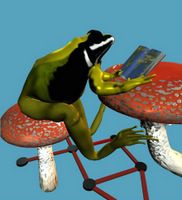
To start with, since I'm actually a large amphibian Here are some important lessons from The Way of the Toad
  • Kill and eat anyone smaller than you
  • Run away or hide from anyone larger
  • If you get into a fight with someone larger, poison them
  • Praying Mantis is over-rated
  • White Crane is terrifying
From my cats
  • You'll never stay in fighting shape if you don't get your 16 hours of sleep a day
  • Kill from ambush
  • Killing goes better with torture
  • Eat what you kill but leave the not-so-tasty bits all over the house
  • Learn knife fighting first
  • If you're not afraid of a German Shepherd you must be as big as a German Shepherd. If you know it, so will everyone else
From sloths
  • The best defense is being so still and covered with moss that nobody sees you
  • Haste makes waste
  • The most vulnerable time of day is when you climb out of bed to defecate.
From bonobos
  • Make love, not war
  • Make more love, not war
  • Make really inventive love with your friends and neighbors, not war
  • Make love swinging from trees, in large groups and with everyone except your mother, not war
From bees
  • Only the Queen uses her sex organs for sex
  • The rest of us fight with them
  • And then we die (bee stings are modified ovipositors)
From elephants
  • Size is everything
From amoebae
  • Pound for pound, the amoeba is the most vicious creature on the planet
  • Eat your enemies
From plants
  • Plants give amoebae a run for their money
  • If you're not using it to eat, build, or have sex use it to kill something
  • Strangle your enemies
  • Starve your enemies
  • Poison the ground that they live on
  • Once you kill them, eat them
From skunks
  • If you have chemical weapons you don't need to be smart, strong or tough
From ants
  • Mindless ferocity and large numbers beat everything